x
N
A
R
A
N
G

- Email: drsamir@narangeyecare.com
- Email: drpriya@narangeyecare.com
- Call: +91 079 26420034 | +91 9724648783
Cataract
Cataract
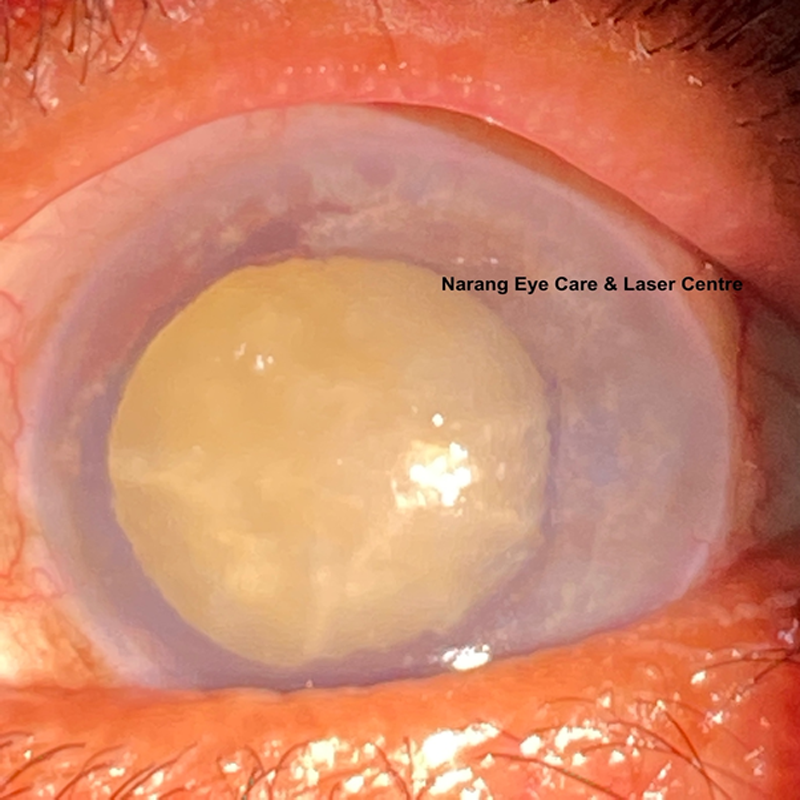
Cataract is the clouding of the natural lens present in the eye. This process is usually encountered in patients after 40-45 years but in some cases, it may present at a younger age too.
In infants associated with other abnormalities, cataract maybe be present at birth also. Immediate treatment with surgery is necessary for adequate development of vision in young children.
DIFFERENT TECHNIQUES FOR CATARACT SURGERY :
Phacoemulsification
Phacoemulsification is the preferred method in most cases. It involves the use of a machine with an ultrasonic handpiece equipped with a titanium or steel tip. The tip vibrates at ultrasonic frequency (40,000 Hz) and the lens material is emulsified. Fragmentation into smaller pieces makes emulsification easier, as well as the aspiration of cortical material. After phacoemulsification of the lens nucleus is completed, a dual irrigation-aspiration (I-A) probe or a bimanual I-A system is used to aspirate out the remaining peripheral cortical material. A foldable intraocular lens is then injected from the corneal incision.
Micro incisional Cataract Surgery (MICS):
In this technique, phacoemulsification is done through an ultra-small incision whose size can vary between 0.7 – 1 mm. This technique offers an advantage of ultra-small incision.
Sutureless Cataract Extraction:
This technique is advantageous in cases where phacoemulsification is contraindicated. Although it is a sutureless technique, the size of incision varies upto nearly 5-6 mm.
Conventional extracapsular cataract extraction (ECCE):
Extracapsular cataract extraction involves the removal of almost the entire natural lens in toto while the posterior elastic lens capsule (posterior capsule) is left intact to allow implantation of an intraocular lens. It involves manual expression of the lens through a large (usually 10–12 mm) incision made in the cornea. Although it requires a larger incision and the use of stitches, the conventional method may be indicated for patients with very hard cataracts or other situations in which phacoemulsification is problematic.
TYPES OF INTRAOCULAR LENSES OFFERED
Customized treatment for cataract is offered at our centre to meet the visual requirements of each patient. Vision can be corrected for distance, intermediate as well as for near.
MONOFOCAL
These lenses are recommended for patients who have minimal or no astigmatism. Adequate vision correction for distance can be achieved with these lenses. When patients have cataract in both eyes, customization of power of intraocular lens can be done for each eye and the patient can be spectacle free for most of the time. correct vision for distance.
TORIC LENSES
These lenses are recommended for patients who have minimal or no astigmatism. Adequate vision correction for distance can be achieved with these lenses. When patients have cataract in both eyes, customization of power of intraocular lens can be done for
MULTIFOCAL
These lenses have multiple rings, and they provide correction for distance, near and intermediate vision. These lenses decrease the dependency on glass, but some cases may need to wear glasses for full optimization.
EXTENDED DEPTH OF FOCUS LENS
These lenses provide spectacle independence over a broad range of distance. Some patients might need glasses for reading very fine print.
TRIFOCAL LENS
Trifocal lenses are one of the latest modalities for cataract treatment. These lenses form 3 focal points for distance, intermediate and near vision. For further details please discuss with our team and we will guide you accordingly.
POST- OPERATIVE CARE :
Following surgery, the patient is discharged after a short stay in the outpatient recovery area.
The patient is advised to administer eye drops, as prescribed by the surgeon, several times daily during the next few weeks.
The patient can wear sun shades to help protect the eye in bright light.
During the first week of recovery, it is essential that the patients should avoid:
- Strenuous activity and heavy lifting
- Bending, exercising and similar activities that might stress the eye while it is healing.
- Water that might splash into eye and cause infection. Keep your eye closed while showering or bathing. Also, avoid swimming or hot tubs for at least two weeks.
- Any activity that would expose your healing eye to dust, grime or other infection-causing contaminants.
Always follow your surgeon's specific instructions, which you will receive prior to your discharge from the outpatient department.